Gizmodo Has 13,116 New Ways to Accuse Gizmodo of Using AI
Modal Path Ethics downloaded the data. This matters.
Gizmodo Has 13,116 New Ways to Accuse Gizmodo of Using AI
Modal Path Ethics downloaded the data. This matters.
Gizmodo has published a useful demonstration of why a frequency table should not be allowed to become a detective.
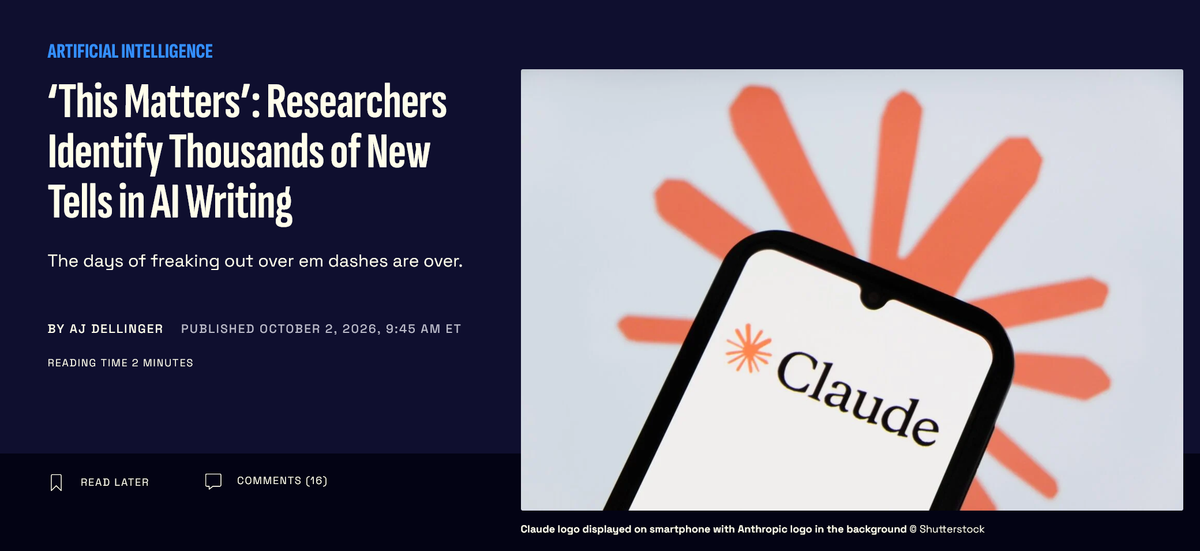
AJ Dellinger’s October 2 article, “‘This Matters’: Researchers Identify Thousands of New Tells in AI Writing”, reports on Graphite’s AI-writing study. It calls “this matters” a “giveaway,” says Claude Opus 5.5 is “plagued” by it, and presents several other high-ratio phrases as tells readers can recognize.
There is one problem.
Graphite explicitly says not to do that.
Graphite’s study is a corpus comparison. It asks which words, phrases, and frames occur disproportionately often in model-generated web articles compared with a pre-ChatGPT human web corpus. Its authors explicitly say they do not recommend classifying authorship from individual tells. The study also says its tells depend on corpus construction, may differ outside web articles, may capture changes in human writing since 2022, and would likely change under a different generation prompt.
Gizmodo translated this into: giveaway.
So Modal Path Ethics downloaded Graphite’s released data.
This went pretty badly for Gizmodo.
Modal Path Ethics Ran Gizmodo Through the Thing Gizmodo Thinks It Has.
Graphite’s October update reports 2,548 tells for Claude Opus 5.5 alone. Applying Graphite’s published frequency, ratio, and frame thresholds to the updated downloadable table gives 13,116 distinct qualifying words, phrases, and frames across the ten model corpora in that release.
Then Modal Path Ethics ran Dellinger’s Gizmodo article through a simple surface replay of that released list: exact n-grams, with Graphite-style frame blanks allowed to span one to three words.
The article body hits 127 distinct features on the updated tell list.
That number is obviously inflated by the fact that Dellinger is writing an article about the tells and therefore repeats several of them.
Fine.
So delete the three paragraphs where he introduces the headline examples, including “this matters,” “looking ahead the,” “why [blank] matters,” “dependable,” and “does not establish.”
The remaining article prose still hits 73 distinct features from the released cross-model tell list.
Among them are “perhaps the most,” “far more,” “over time,” “harder to,” “closer to,” “more likely,” “difference,” “trend,” “tells,” “generic,” “actually,” “every,” and “moving.”
This does not establish that AJ Dellinger used artificial intelligence.
Please hold that sentence tight for a moment.
This does not establish that AJ Dellinger used artificial intelligence.
The Forbidden Paragraph.
Because Gizmodo has volunteered language itself for forensic duty, this article will now employ every one of the 32 exact words, phrases, and frames Graphite chose to spotlight in its Opus 5.5 update.
We will try to remain dependable, thoughtful, steady, and meaningful while doing so.
What comes next is unfortunate. Graphite literally flags looking ahead the as a tell. The downloadable data adds another layer to the joke because, in practice, the method is useful for corpus comparison rather than simply useless. This is more than a joke; it is a jurisdiction problem. It is not only about Claude; instead it concerns what happens when a population statistic is promoted into evidence about a person.
This matters. Why this matters is not difficult: authorship is what matters most once an instrument starts accusing writers, and just as important, a corpus result may provide evidence about distributions while not simply identifying whoever wrote the paragraph in front of you. A phrase does not establish provenance and is not necessarily suspicious in an individual document.
Graphite also compares the most popular, perhaps the most, the most powerful, and one of the best things about patterns across models. A corpus is especially helpful when it can help you measure population differences, makes it easier to compare systems, and helps you avoid relying on vibes. The underlying research is genuinely interesting. It matters enormously for model characterization and contains an enormous amount of useful evidence.
Using that evidence as a phrasebook for identifying human cheaters would be remarkably stupid.
There.
We are now fully artificial.
Unfortunately, AJ Dellinger Has Been Writing Like This for a While Now.
Again: none of the following establishes AI use. That is why it is funny.
Dellinger has previously written about a “slow but steady drip” of surveillance details at Madison Square Garden. He has called token use a “meaningful benchmark” and described AI accessibility as a “meaningful improvement”. He has opened a Truth Social description with “In practice”, and another article says “turns out in practice.” He wrote “Instead, it breaks it down” while describing YouTube policy. He used the Tolkien line “One does not simply walk into Argentina”, giving us “not simply” in the most recognizably human way possible.
He has written “it’s not necessarily sustainable”. He has used “perhaps the most” repeatedly, including again in America.gov coverage. He put “The Most Powerful AI Models” directly in a headline. He wrote that a Google update “makes it easier” to remove personal information from search. He put “Remarkably” in another headline.
Under the Gizmodo reading of Graphite, AJ Dellinger is therefore showing severe symptoms of Claude, Astra, Opus 5, Opus 5.5, and whatever else happens to share his vocabulary this week.
Under the sane reading, meanwhile, AJ Dellinger is a person who writes English.
Gizmodo Has Been Infested for Years.
The problem does not stop with one writer.
Gizmodo has published “a thoughtful response”. It has repeatedly asked “what comes next”. It has written “rather than simply”, “matters most”, “just as important”, “may provide”, “the most popular”, “the most powerful”, and “one of the best things about”.
Its current Download Hub also supplies “not only about”, “is especially helpful”, and “helps you avoid”. Historical Gizmodo prose contains “an enormous amount”, while “remarkably” has been living comfortably in Gizmodo headlines and science prose for years.
Some examples are staff journalism. Some are quotations. Some are Download Hub copy. That distinction matters because provenance matters. A phrase appearing somewhere on a domain does not tell you who produced it, how it got there, whether it was quoted, or whether a model touched it.
Which is an excellent miniature version of the entire problem.
Graphite Did Not Build the Witchfinder.
Graphite’s actual experiment is more constrained than Gizmodo’s framing suggests.
The human side consists of web articles published before ChatGPT. The model side was generated from summaries of those articles. Every model was instructed to act as an “expert content writer,” write in a “professional yet friendly tone,” and address people “searching on the web for key terms related to the topic.”
That is a web-content-writing task.
Graphite then measured the linguistic habits of models performing that task against older human web writing.
This is legitimate corpus analysis. It is also a very specific field.
Graphite says a different prompt would likely produce different tells. It says post-2022 human style changes may be misidentified as AI-associated features. It says its results may differ outside web articles. It says not to classify authorship using individual tells.
The warning label is attached to the instrument.
Gizmodo peeled that shit right off and wrote GIVEAWAY on the front.
We Already Killed the Em Dash.
There is an additional comedy here.
For fucking years, the em dash was treated online as a scarlet letter for artificial intelligence. Humans were accused of machine writing because they used punctuation that predates the computer.
Now Graphite reports that Claude Opus 5.5 uses em dashes 99 percent less often than Opus 5 and much less often than the pre-ChatGPT human corpus. Astra also uses them far less often than those humans.
So the social detector succeeded. Congrats.
People learned that the em dash looked “AI.” Model makers and users pushed models away from it. Humans became nervous about using it. The signal changed because the signal had become a target.
Now Gizmodo informs us that the days of freaking out over em dashes are over.
The punctuation mark has been released for time served.
“This matters” can report to processing.
The Actual Tell.
There is an actual tell in this story.
It is not “this matters.”
It is the conversion of a distribution into a verdict.
A population-level frequency difference can be real and informative without licensing an inference about a particular member of the population. Graphite found lexical and structural tendencies in controlled corpora. Those tendencies can help characterize model families, compare versions, study stylistic drift, and improve more sophisticated detection work.
They do not turn ordinary English into contraband, AJ.
If your detector can accuse the journalist explaining the detector, the journalist’s earlier work, decades of the publication hosting him, and the human comparison class from which the language came, perhaps the phrase was never the giveaway.
Perhaps the giveaway was thinking you had one.