
AI Did Not Blur Reality
Fictional Earth was already doing that. Artificial intelligence made it less dependent on Earth.
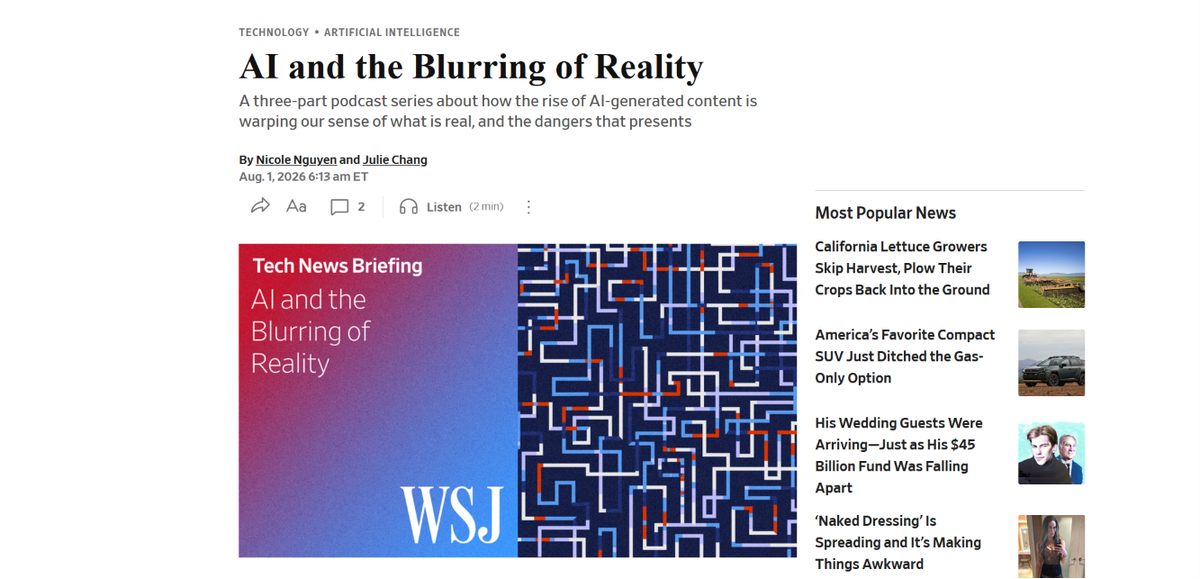
The Wall Street Journal is locating the rupture at the wrong layer.
Its new three-part series, “AI and the Blurring of Reality,” examines artificial dubbing, synthetic performances, digital influencers, deepfakes, and Granny Spills: an artificial-intelligence-generated luxury grandmother who attends festivals, poses beside celebrities, offers relationship advice, and appears to be having a much better retirement than everyone’s actual grandmother. The series asks what happens when people can no longer reliably distinguish authentic media from synthetic media.
The concern is real.
The chronology is wrong.
Reality did not remain intact inside social media until generative artificial intelligence arrived.
Social media had already constructed a second terrain over Earth. Fictional Earth names factual material rebuilt under platform physics. A real war becomes combat weather. A real death becomes affect. A real body becomes proof. A real career becomes acceptable posture. The platform takes extant material, converts it into native objects, ranks those objects, and teaches users to experience the reconstruction as the event itself.
- A person becomes an account.
- A life becomes a profile.
- A tragedy becomes discourse.
- A field becomes a feed.
Generative artificial intelligence adds something genuinely new to this machinery.

It gives Fictional Earth native inhabitants.
The Grandma Was Already Fictional.
Granny Spills is interesting because her platform character has no continuous human life behind it.

Human influencers were already divided across two bodies: the living person and the platform person produced from them. The account is edited, scheduled, filtered, branded, ranked, and corrected against metrics. It presents a person-shaped object optimized for circulation.
The human being still creates friction.
They sleep. They age outside the content plan. They dislike things. Their relationships produce claims. Their body has limits. Their biography can resist the brand. The account must keep returning to a life that cannot be rewritten from scratch every morning.
Granny Spills removes that return path.

Her creators describe her through long prompts, place her beside celebrities, send her to festivals, and tune her personality toward what the internet rewards. They openly describe the character as shock-driven: an elderly woman behaving in ways the feed finds surprising, profane, aspirational, and shareable. Her Instagram account reportedly reached one million followers in 22 days and later exceeded two million.
Some viewers know she is synthetic. Some miss the labels. Some recognize the trick and enjoy it anyway.

The platform does not need to settle the grandmother’s metaphysical status.
It needs the post to hold attention.
Granny Spills is native Fictional Earth fauna.
Fictional Earth previously extracted characters from people.
It can now generate characters directly.
The Last Human Alibi
The old platform retained a biological alibi.
Somewhere behind the account lived a person. Somewhere beneath the compressed post, something had happened. The platform reconstruction had borrowed its raw material from Earth.

Generative artificial intelligence weakens that dependency.
A synthetic influencer can have:
- a childhood that never occurred;
- relationships with no participants;
- scandals with no underlying event;
- endorsements without belief;
- grief without loss;
- travel without movement;
- age without time;
- continuity without a continuous body.
The object can be produced directly inside the grammar that will rank it.
This is the transition the Wall Street Journal has encountered.
The danger reaches beyond confusion over whether one image is authentic. Fictional Earth can begin sourcing material from itself.
Platform-native characters generate platform-native events. Those events produce engagement data. That data guides the next characters, performances, controversies, and events. The field stops translating Earth and begins farming its own earlier translations.
No synthetic image has to fool everyone.
It only has to enter the weather.
Provenance Is Real.
Contact Is Deeper.
The Wall Street Journal correctly identifies a growing verification tax.
Researchers in the first episode describe a condition of perpetual skepticism. Even people who study synthetic media now encounter an ordinary video and wonder whether the scene actually occurred. The episode also distinguishes deception inside an individual post from the systemic effects of synthetic material flooding platforms that already function as social infrastructure.
That second concern reaches the deeper layer.
A provenance label can tell a user that Granny Spills is artificial-intelligence-generated. It cannot explain what the account is training the audience to reward.

Verification can establish that a video is authentic. It cannot restore the event from the platform grammar that converted it into outrage, proof, aspiration, ridicule, entertainment, or consumable concern.
- A true post can still destroy contact.
- A false post can still organize real behavior.
A Fictional Person can influence purchases, expectations, speech, style, politics, relationships, and the perceived texture of ordinary life. Once the object enters the platform field, its consequences become extant even when its biography never was.

“Real or fake?” therefore catches only the first problem.
The stronger questions are:
- What field produced this object?
- What behavior does the platform reward it for producing?
- Which response is it training into the user?
- What extant person, event, or institution can correct it?
- Where do its consequences land outside the feed?
An artificial-intelligence label answers one of these questions.
Reality Was Already Being Generated
Fictional Earth never required wholesale fabrication.
Its great power came from conversion.

It could receive accurate information and still distort the field. It could take real suffering and turn it into belonging ritual. It could take courage and turn it into content. It could take moral language and increase its circulation while weakening contact with the harm that language was supposed to reach.
Generative artificial intelligence accelerates this process by allowing the platform layer to manufacture its own inputs.
The feed no longer has to wait for:
- a person to live an interesting life;
- a celebrity to attend an event;
- a grandmother to develop a personality;
- a relationship to produce conflict;
- a camera to capture a surprising moment;
- a real scandal to generate discourse.
The synthetic layer can supply each object on demand.
That changes the platform from a distortion machine into a partial reality-production system.
The resulting objects remain dependent on Earth in deeper ways. They require energy, data centers, labor, training material, creators, audiences, brands, and bodies living outside the interface. Fictional Earth has not achieved independence.
It has achieved greater distance from the events and persons it claims to show.
That distance is enough to matter.
The Ruling
Artificial intelligence did not encounter a clear social reality and begin blurring it.
Social media had already translated reality into platform weather, ranked it, compressed it, and taught billions of people to consult the resulting atmosphere before deciding what the world felt like.
Generative artificial intelligence creates a real escalation. The fictional layer no longer needs to wait for enough people, performances, photographs, scandals, relationships, and grandmothers to arrive from Earth.
It can produce the raw material of its own weather.
The Wall Street Journal has found the synthetic citizen.
Fictional Earth built the country years ago.
Artificial intelligence did not create Fictional Earth.
It made Fictional Earth less dependent on Real Earth.